• Wildlife on the Rwanda-Uganda Primate Safari

    The volcanic ranges of central Africa hold about 700 Mountain Gorillas and many other primates. Our group of ten JOURNEYS travelers made a concerted effort to see as many of these rare primates as possible in Rwanda’s Volcanoes National Park, Uganda’s Impenetrable Forest and other special reserves.

    Rwanda’s Return
    We began our trip in Kigali, Rwanda. By African standards Rwanda is clean, prosperous, well-fed, safe and environmentally aware. Plastic bags are illegal. Traffic rules are enforced. Markets are stocked and the roads are in good repair. Private investment is in evidence. Since the genocide of a hundred terrible days in 1994, the country has rebuilt itself politically, socially and economically. I last visited Rwanda in 1992 when the situation was tense. Today there is still grieving and anger, but also healing. Through a vast amount of international aid, all aspects of society are being repaired. Every visitor should see the National Genocide Museum in Kigali. It helps us appreciate the futility of saving other species if we do not respect and preserve our fellow humans.

    On the Trail of Mountain Gorillas
    The Mountain Gorillas of Parc National Volcanoes are in good hands and their numbers are growing. There are two distinct and separate populations. One ranges through three countries in the contiguous protected reserves of the Congo, Rwanda and Uganda. These animals are most reliably, safely and conveniently visited from near the Rwanda town of Ruhengeri. We stayed 40 minutes away in the spectacularly sited Virunga Lodge high on a ridge between two caldera crater lakes overlooking the volcanic peaks where the gorillas live. Gorilla viewing permits are limited to eight persons per day per family group of habituated gorillas. Visits are limited to one hour and occur in the morning when the animals are likely to be feeding. Reaching the free-ranging group for which you have a permit may require up to three hours of hiking each way, but in our experience the total time from departing the headquarters orientation session and checking back in after the visit was more typically 3-4 hours. My sense was that the older the traveler, the more likely they would be assigned to one of the groups requiring less walking. Permits cost $500/ person per visit. These usually must be acquired months in advance and every available daily permit is pre-sold. Gorilla tracking takes place 365 day a year. It can rain any day, but there are more wet days in April, May and November. Because the gorillas often cross international borders or wander to inaccessible locations, the number of groups which can be visited on any one day may range from 6-8, but visits to designated “research groups” can take up the slack if regular tourist groups are not accessible. Trackers pre-locate the habituated groups early in the morning and radio their location to the guides leading the tourist visitors.

    Encountering Gorillas
    While the park rules suggest you must be at least seven meters from the animals to prevent transmission of disease, as a practical matter, the habituated gorillas seem to ignore humans and often wander directly toward the awed human apes. The gorillas are vegetarians and very peaceful, albeit powerful. In 1992 we were given explicit instructions about avoiding eye contact, bending down, being quiet and giving especially wide berth to the silverback patriarch of the group. We received no such instruction in 2009, and it did seem like the gorillas were oblivious to our presence. I think all of our group obtained great photos similar to the ones in this review. Each visitor receives a souvenir certificate of accomplishment upon return to check back in at the headquarters. For those who prefer not to carry their pack, lunch, raincoat and camera gear, porters are available for $10 in Rwanda and $15 in Uganda. The porters tend to be former poachers or farmers whose fields are sometime feeding grounds for gorillas and other animals on the edges of the park. Rain is possible anytime of year and the terrain can be muddy, steep and prickly. Gorillas seem to love eating nettles, enormous thistles and bamboo. Long pants, hiking boots, long sleeves and gloves are useful if not essential in this habitat.

    In the course of our trip we had four encounters with four different gorilla groups. Each was a different experience with respect to the habitat in which the gorillas occurred, the behaviors we observed, number of gorillas in the family group, and the distance the group traveled during the hour we spent with them. We had the impression that poaching in Rwanda and Uganda was essentially ended, though may still be a problem in Congo. The total population is slowly increasing. We happened to arrive on the Gorilla Naming Day, an annual event of national significance during which each of the newly-born gorillas receives an official name. There are speeches, dancers, music and media coverage. On this particular day, Jack Hanna representing ABC Good Morning America covered the event for international broadcast.

    We drove from Rwanda to Uganda and spent a night at Mount Gahinga Lodge at the edge of Mgahinga National Park. There were no gorilla groups in the area, but we made a hike into the park to look for the most colorful bird in the country, the Ruhenzori Turaco, which we did find. The lodge was a very friendly place serving spectacularly tasty meals and with a bird bath attractive to lots of birds.

    Entering the Impenetrable Forest
    We drove to Uganda’s Bwindi impenetrable Forest National Park, home of the other, separate, Mountain Gorilla population. The drive through rural Uganda was really scenic as the road wound through hilly, lake-dotted, volcanic terrain sculpted by terraced fields containing corn, bananas, cassava, beans, squash, tea and coffee. Cassea trees were in bloom with their bright yellow blossoms. Numerous pairs of Crowned Cranes, Uganda’s national bird stalked insects in the farm fields. Children in brightly colored school uniforms walked to classes and waved to us as we passed. Bwindi park is lush, steep and inviting. As you move west across East Africa rainfall increases as does species diversity and the amount of land in natural vegetation. Bwindi’s forest hold a dozen species of primates including Chimpanzees. Our lodge in Bwindi offered a spectacular view into the rainforest and even offered the treat of an intense, but brief, thunderstorm just after we checked into our cottages. From our base at Volcanoes Bwindi Lodge we made two visits to Gorilla groups.

    Tracking gorillas in Uganda follows much the same protocols and rules as Rwanda. My own sense was that Rwanda is better organized and more efficient in staffing and managing the activity. In both destinations, the parks staff divides the day’s participants into parties of eight with each group assigned to a gorilla group. There were occasions where it seemed the park was not following its own rules regarding maximum permissible numbers of visitors, but overall we had capable guides and efficient trackers who were able to show us the primates with a minimum of hiking and a maximum of understanding of what we were seeing.

    Chimpanzees and other Primates
    We tracked chimps in four locations in Uganda. They were a bit more elusive than the gorillas. Chimps spend more time in the tops of trees and they are faster moving through the forest. Chimps vocalize more, but also seem to cover a larger daily range and have a broader diet, often including other primates. I particularly enjoyed tracking chimps in Kibale forest. We visited part of a large group which was separated from the rest of its membership. As we watched there was a wild chorus of hooting and calling across the forest and the group reunited with embraces and swinging of arms before settling into casual eating, mutual grooming and resting.

    On our two-hour hike in Bigodi Community Forest Swamp during a rainstorm, we saw more species of primates at the edge of agricultural lands than anywhere else on the trip. Local farmers, with the help of a Peace Corps Volunteer about 20 years ago, decided to protect an area of Raphia and Papyrus both to preserve the natural vegetation and give sanctuary to the nine species of primates in the area. A local resident conducted our walk, pointing out seven species of primates and many of the 137 species of birds known from the area. The primates sometimes create a nuisance for local farmers, leaving the swamp and forest to raid crops, but income from the guided hikes provides compensation, pays the guides and supports a local school.

    Also Fantastic for Birds and Other Mammals
    While the chimps, gorillas and primates may be primary reasons to visit Uganda, the country is one of the best in Africa for birding with more than 1000 species. Uganda has two huge national parks; Queen Elizabeth and Murchison Falls, both offering vast savannas that are well populated by antelope and their predators. Queen Elizabeth park has famous tree climbing lions. Murchison Falls, on the upper Nile, hosts some the highest concentrations of hippos and crocodiles in Africa. Both offer water-based safari cruises which offer spectacular access to bird and animal photography opportunities. There are also numerous other parks and reserves in Uganda providing wonderful opportunities for customized nature trips.

    Cause for Celebration and Resolve
    My best moments on this trip involved the contact with the gorillas and chimps. One might think that because these primates are habituated to accept the proximity of humans, the result is a zoo-type experience. This not at all the case. In my opinion the habituation is a celebration of our capacity to understand and protect these animals. When you are very close and able to hear them chewing, when you can smell them and make actual eye contact, you also appreciate their vulnerability. In a sense, these few animals still exist because we pay to see them. Millions have been lost throughout Africa and the rest of the world because we did not create either the inter-species relationship or the economics to justify their preservation.

    For all the members of my travel group, the experience was inspirational on many levels. We could not help but see our own primate reflection in their eyes and in their circumstances. We must continue to ask what we must we do to make sure all of these marvelous animals continue to live in a sustaining environment and in peace.

    Thanks to all my fellow participants. (Standing from left) Charlene Henderson, Larry Miller, Judy Miller, Bill Livengood, Barbara Bailey, Will Weber, Gordon Whyte, (seated) Carol Kulak, Dietrich Geschke, Lynda Linker

    Tags: , , , , , , , , ,

  • 07 Aug 2009 /  Uncategorized

    I visited Point Mouillee from about 6-11 am Thursday, August 6 and recorded thefollowing list of 77 species.  It was a full moon  morning and the most memorable sighting of the visit was watching a Comon Loon fly across the disk of the moon just before dawn.  The other outstanding species included An American Avocet in Cell 3.  There was also a Red Knot, 3 Ruddy Turnstones and 6 Sanderlings in Cell 3 along with may other shorebirds, terns and a few Lesser Scaup.

    Just across from Cell 3 there were 8 White Pelicans preening near  the rookery island in the Lead Unit. I did not see them flying during my visit. There are at least three and perhaps 5 Snowy Egrets which do fly betwen the Lead and Vermet Units.
    Canada Goose     175
    Mute Swan     2
    Wood Duck     50
    American Wigeon     2
    American Black Duck     1
    Mallard     125
    Blue-winged Teal     15
    Northern Shoveler     2
    Green-winged Teal     4
    Redhead     4
    Ring-necked Duck     1
    Lesser Scaup     4
    Ring-necked Pheasant     1
    Common Loon     1
    Pied-billed Grebe     80
    American White Pelican     7
    Double-crested Cormorant     25
    Great Blue Heron     150
    Great Egret     230
    Snowy Egret     4
    Green Heron     1
    Black-crowned Night-Heron     20
    Osprey     2
    Bald Eagle     1
    Northern Harrier     1
    Common Moorhen     4
    American Coot     120
    Semipalmated Plover     20
    Killdeer     75
    American Avocet     1
    Spotted Sandpiper     6
    Solitary Sandpiper     3
    Greater Yellowlegs     14
    Lesser Yellowlegs     200
    Marbled Godwit     1
    Ruddy Turnstone     3
    Red Knot     1
    Sanderling     6
    Semipalmated Sandpiper     200
    Least Sandpiper     20
    Pectoral Sandpiper     4
    Stilt Sandpiper     3
    Short-billed Dowitcher     40
    Bonaparte’s Gull     2
    Ring-billed Gull     25
    Herring Gull     10
    Caspian Tern     50
    Common Tern     5
    Forster’s Tern     7
    Mourning Dove     12
    Eastern Screech-Owl     1
    Chimney Swift     4
    Northern Flicker     1
    Eastern Kingbird     6
    Warbling Vireo     2
    Purple Martin     10
    Tree Swallow     200
    Northern Rough-winged Swallow     3
    Bank Swallow     30
    Barn Swallow     125
    swallow sp.     200
    House Wren     1
    Marsh Wren     3
    American Robin     6
    Gray Catbird     2
    European Starling     150
    Cedar Waxwing     4
    Yellow Warbler     3
    Savannah Sparrow     3
    Song Sparrow     4
    Northern Cardinal     5
    Indigo Bunting     3
    Red-winged Blackbird     X
    Common Grackle     X
    Brown-headed Cowbird     50
    House Finch     2
    American Goldfinch     15

  • 13 Jul 2009 /  Uncategorized

    I returned this month from a spectacular experience in Rwanda and Uganda tracking gorillas, chimps and other primates.

    See my photos at http://gallery.me.com/weberwill#100069

    Mountain Gorilla savors thistle in Rwanda

  • 23 Feb 2009 /  Uncategorized

    The images below were taken with an iPhone through a Kowa TSN 883 scope at 30X.  This bird at first presented as a Common Goldeneye, but then I noticed white markings behind the eye rather than in front of the eye, a black, merganser-like bill and a slight crest, though it was closer to a goldeneye size.  The bird was in the open water of Ford Lake where the Huron River enters the lake under - I-94.  I took the pictures about 3PM Friday, Feruary 20, 2009 from the boardwalk/path accessible from North Bay Park, Ypsilanti. The closest trail entrance is off of S. Grove Street.  The bird was still there on Sunday morning, Feb 22.  I saw it flying with three Common Goldeneyes, but I could not get close enough to get a better picture. One person who has seen the picture suggests it could be a Common Goldeneye x AmericanMerganser cross.  This is possible, but the bird is goldeneye size and has a black bill.

    Possible Common Goldeneye x Hooded Merganser hybrid

  • National Geographic, publisher of Adventure Travel magazine awarded JOURNEYS International top honors for a second year in a row in the prestigious “Do-It-All Adventure Travel” category.

    Buddhist monk in Kamu Village in a remote area of LaosNational Geographic Adventure surveyed clients of more than 240 adventure travel companies around the world and ranked them according to education, sustainability, quality of service, spirit of adventure and client satisfaction. Ranking in the top ten in all categories, JOURNEYS scored 100% for client satisfaction.

    “We are honored by National Geographic Adventure and our clients for awarding us one of the highest recognitions in the adventure travel industry,” states Joan Weber. “We are dedicated to continuing to provide travelers with ecologically responsible trips that will delight the senses and renew the spirit.”

    In 1978, before the terms eco-travel, sustainable travel, or responsible travel became popular, Will and Joan Weber, the founders and directors of JOURNEYS International, took a small group of open minded travelers on a journey to discover Nepal. Their hope for this trip was to provide their travelers with an emotional and spiritual experience as well as a physical one .  The tour involved learning about the local culture and the natural environment through direct, respectful interaction and contributing to the preservation of the Nepalese culture.  Since then, the JOURNEYS staff has continually searched for new destinations and new ways for clients to experience them. “At JOURNEYS, adventure travel means more than just a physical experience – it should be emotional, intellectual and spiritual too,” according to the editors of National Geographic Adventure. “Clients explore these inner realms during tours that might include a mediation session with Buddhist monks in Ladakh or hang time with local healers in the volcanic highlands of Guatemala”

    The woman of Mbitini village welcome travelers with ceremonial escort.

    For more information on JOURNEYS family trips, community based tours or other types of adventure travel go to www.journeys.travel or call 1-800-255-8735.

    About JOURNEYS International:
    JOURNEYS International of Ann Arbor, Michigan, was recently chosen by National Geographic Adventure magazine as one of the Ten “Best Outfitters on Earth.” JOURNEYS International has specialized in ecotourism since 1978. They offer the best nature tours, safaris, treks, adventure travel, family and cultural trips on earth. Whether it is called an eco-vacation, adventure travel, eco-travel, eco-tour, sustainable travel or responsible travel, for 30 years they have been creating ecologically sensitive and culturally responsible travel to exotic destinations around the world. Specialty eco-trips include women’s tours, Kilimanjaro climbs, exploration cruises, festival trips, student group trips and cross cultural and wildlife safaris. For more information about this trip or other JOURNEYS trips visit www.journeys.travel or contact JOURNEYS at 800-255-8735.

    Tags: , , , , , , , , , , , , , , , , , , , , ,

  • 03 Dec 2008 /  Uncategorized

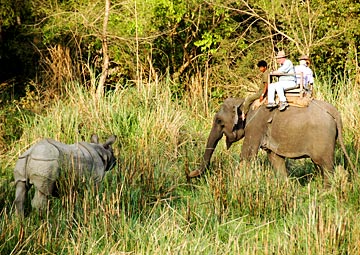
    Ride an elephant in search of wildlife in Chitwan Natinal Park, Nepal. On our recent Wild Himalaya trip to Nepal, Bhutan and India, I had the good fortune to take several elephant safaris in Chitwan Natinal Park.  On the same trip I rode the elephants in Kaziranga Park in Assam. The Chitwan experience is a better quality experience. On both trips we saw the One-horned Rhinoceros in some numbers, but the Chitwan safari was less routine, involved fewer elephants and was more adaptable tot he interests of clients. We saw more large mammals in Kaziranga including swamp deer, wild boar and wild elephants at a distance, but these animals were all better, more closely and more easily observed from vehicles in Kaziranga.  In Chitwan you feel that an elephant is essential.  Tall grass, deep mud, running streams don’t stop the elephants.  There always seemed to be more potential for an exciting sighting in the relatively dense vegetation of Chitwan. In Kaziranga, much of the ride was across short grass meadows. The deer or rhino were visible from a distance and it was just a matter of walking up to them. In both park the ride lasted about an hour or so, but in Kaziranga it is really not worth doing more than one ride because all the elephants seem to follow the same defined route each time. Do choose to take the earliest ride in the morning, if you have the choice.  This will increase the liklihood of seeing the rarer mammals and birds. In Chitwan the route is more spontaneoous and keyed to the interest of the client and the prospect of seeing different species. Ask your mahout to stop or maneuver for the best pictures.

    Both locations were better than the rather contrived and limited elephant game rides in other parks of India.

    if you have never ridden an elephant in search of wildlife, do so whereever you are, but if you are seeking the best place to enjoy the exciting experience of viewing and photographing wildlife from an elephant JOURNEYS recommends using the elephants of Temple Tiger or Island Jungle Resort in Chitwan National Park in Nepal.

    You are likely to get quite close to rhinos. No telephoto lens necessary.

    Getting close to a rhino in Chitwan National park

  • 02 Oct 2008 /  Uncategorized

    On Oct. 2, 2008, India put into effect a nationwide ban on smoking in public places.  Long time travelers will recall the days when smoking throughout South Asia was widespread, especially among educated people.  Not any more.   While China and Japan still have work to do in educating their citizenry, countries like India, Bhutan, Thailand and Cambodia have taken bold action to reduce tobacco consumption and tobacco smoke pollution. Non-smokers are much less likely to be inconvenienced by smokers in Asia than they will be in Europe.

  • 12 Sep 2008 /  Uncategorized

    Tiger tracking in Nepal, India, BhutanJOURNEYS’ Wild Himalaya trip Nov 2-23, 2008, will include the first trek ever permitted in a wild region of eastern Bhutan.  JOURNEYS received special permission from the Bhutan Department of Tourism to travel with a small group of nature tourists from Buli near Shemgang to Mongar in the extensive virgin broadleaf forest of southeastern Bhutan just north of the Manas area. Rare species such as tiger,clouded leopard,  golden langur and more than 400 species of birds are believed to occur in the area. The full trip itinerary includes prime wildlife sanctuaries in Nepal, Bhutan and Assam, India. The trip is limited to 10 participants and as of this writing four spaces remain.  Call 1-800-255-8735 for detailed itinerary, cost and availability. details.

  • Lhasa, Tibet is accessible by road, air and rail, provided you can get the permits, reservations or vehicles to make the journey.  I had been to Tibet on three previous occasions since 1986 using some combination of air and road travel, but the train trip sounded like a good way to see a great deal of the Tibetan Plateau than the road or air routes.

    The Lhasa Train


    In the Station

    I had just led a group to witness the Total Solar Eclipse of Aug 1, 2008, near Hami in Western China. Four of us from that group flew to Lanzhou where we caught the train to Xining station and began our 27 hour journey to Lhasa. While the rail line exists for many reasons, catering to foreign tourists does not seem to be high on the list. On the day we traveled, there were only 10 foreigners all confined to one car in which none of the conductors or other staff spoke any English. While there were promotional videos, they had little to do with the train and the sound track was in Mandarin. The electronic text crawl sign in the corridor of our  ”soft  sleeper” car in which we traveled consistently mis-named the stops and the expected time between stations.  It was often not clear how long the train would be stopped between stations and whether it was possible or advisable to get off. While the cars and the bedding where clean, there was very little luggage storage space within the small four-berth cabins, and none at all outside of the cabin. This meant that two of the people in our cabin with large luggage had to share the microberths with large bags. Upper berths had no visibility out of the one window in the compartment.  Sleeping car was adjacent to a dining car which had large windows. It was a much more pleasant place to sit than either our sleeper or the non-sleeper coach.  The several hundred Chinese passengers on the train included a very high percentage of smokers and outside of our non-smoking sleeper, the air was blue with smoke. This smoke seemed to permeate all areas of the train via the ventilation system. The dining car served relatively expensive, but mediocre food.  My first meal was breakfast which consisted almost entirely of thin gruel and cold, pickled and fermented vegetables. There was no menu in English.  If you travel this train, bring your own food.  Lunch and dinner were only marginally better and the beer was warm.  The cost and quality of the food meant that not many people actually ate in the dining car, but during dining hours table reservations were still required. During other hours we kept getting chased out of the dining car because there were “staff meetings”.  These seemed better described as staff naps. The train ride was very smooth and quiet and the views were fantastic. We saw numerous herds of chiru or Tibetan Antelope. Herds of yak, high lakes, eagles, ravens and hundreds of snow covered peaks provided an evolving panorama of beauty.  We passed through several long tunnels and the train gained altitude to (supposedly) over 16,600′ at Tangulla Pass, the highest rail point in the world, though we passed this point unceremoniously and without acknowledgement. 

    En route to Lhasa


    The view from the Lhasa Train

      Before we departed the station in Xining, we were required to complete a medical form which seemed oriented at identifying passengers who might find difficulty with the altitude. We were asked detailed questions about heart and blood pressure, diseases and medications we were taking. This all seemed quite responsible  except that no one could speak or read the English answers we provided.  We had been told that oxygen was provided as a courtesy in all the sleepers and this was reassuring, but there were no masks or fittings for the oxygen valves.  Several of us developed headaches and the altitude served to make the bad food even less attractive, but we did not suffer greatly or have serious problems  from the altitude. We arrived into the Lhasa station about 10:30 PM. I was surprised by how many hundreds of people disembarked. There was nothing friendly or welcoming about Lhasa station. There were scores of uniformed and armed security people who formed a gauntlet through which passengers dragged their luggage. There was no porterage assistance available an no baggage carts.  A curfew was in effect and we were told that it was necessary to travel directly to our hotel.  The city was very quiet and the streets eerily empty. On balance it was an interesting trip which offered a view of Tibet with no opportunity to interact.  The train was operated safely and capably, but with no evident effort to demonstrate personal passenger service. Every one was doing their job, and not a bit more. Given the choice of taking the train or having an flown to Lhasa and taking an extra day to travel in the Tibetan countryside by private taxi, I think I would have chosen the plane and taxi. ww

    Tags: , , , , , , , , , , , , , , , , , , , , , ,

  • JOURNEYS International

    JOURNEYS International is proud to announce that Condé Nast has chosen Directors Will and Joan Weber for 2 Top Travel Specialist Awards

    For the 6th year running, Joan Weber, Director and Co-Founder of JOURNEYS International has won the Top Travel Specialist Award for Family Travel:  International Adventure and Eco-travel.  Joan, a former teacher in the United States and Nepal, has an extensive history in planning family travel.  Since the time her children were toddlers, about 20 years ago, Joan and her husband, Will, have been trekking their children across the world to learn about new destinations, cultures and adventures.  She has taken this knowledge and has help plan over 300 annual family trips.

    “The one of the many reasons we have won this award for the last 6 years is that we have learned from our own family travel experiences and have applied these ideas to our trips.  We have learned that good planning does not mean over-scheduling. There need to be spaces of time for discovery and serendipity. We know that parents enjoy our trips when their kids are happy, and we know that kids are happy when they rest, eat well, and participate in engaging activities, which stimulate their curiosity,” States Joan Weber.

    Playing Soccer on our Jambo! Tanzania Family Safari

    For the 5th year running, Will Weber, Director and Co-Founder of JOURNEYS International has won at Top Travel Specialist.  This year he received the Top Travel Specialist for Community Based Tourism.  As a former Peace Corps volunteer and ecotourism pioneer, Will has developed programs through out the world where travelers can stay in private quarters adjacent to a village family’s home, accompany them to market, learn their craft, join them for meals and more. 

    “Through JOURNEYS I have been instrumental in helping local communities in Asia, Africa, the Pacific and Latin America develop a capacity for hosting American tourists. I have served as a consultant to US/AID in this capacity in the Pacific and Guyana. Our company offers high quality community-based tourism in 20 countries. We support financially, through our charitable, non-profit Earth Preservation Fund, numerous incipient programs around the world with an expectation they may grow in capability to host high end travelers in acceptable standards.  Most of our trips throughout the world feature opportunities to add extensions or create whole FIT itineraries based in community-hosted environments, if the main trip utilizes more conventional accommodations. This is not just a matter of responding to growing market for such travel opportunities but a long-term philosophical commitment to building cross cultural strategies for sustaining local communities, cultures and environments.” States Will Weber

    A close encounter with a Rhinoceros as seen on our Wild Himalaya Trip

    For more information on JOURNEYS family, Community Based or other types of adventure travel go to www.journeys.travel  

    Tags: , , , , , , , , , , , , , , , , , , , , , , , , , , , , , , , , , , , , , , , , , , , , , , , , , , , , , , , , , , , , , , , , , , , , , , , , , , , , , , , , , , , , , , , , , , , , , , , , , , , , , , , , , , , , , , , , , , , , , , , , , , , , , , , , , , , , , , , , , , , , , , , , , , , , , , , , , , , , , , , , , , , , , , , , , , , , , , , , , , , , , , , , , , , , , , , , , , , , , , , , , , , , , , , , , , , , , , , , , , , , , , ,